Westlands Constituency

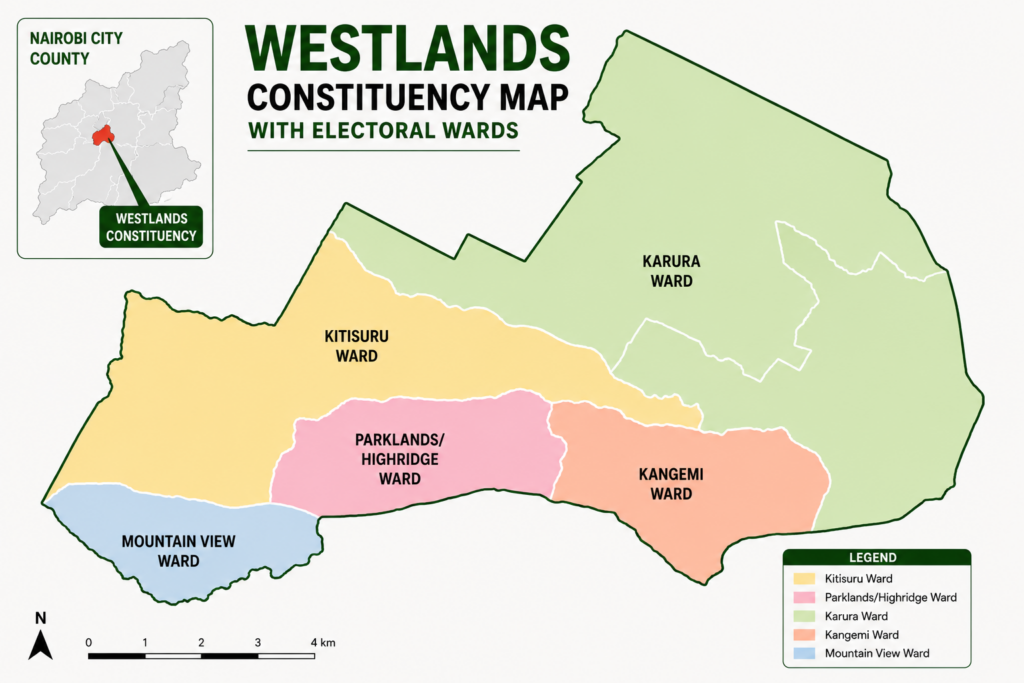
Westlands constituency boundary map

Just 3.3km from Nairobi’s CBD, Westlands feels like a different country. At 8:30 am, traffic crawls along Waiyaki Way.

Inside a glass tower in Westlands, a fintech startup is closing a million-dollar deal. And just a few minutes away in Kangemi, a young man is negotiating for a KSh 500 mjengo job.

Same constituency. Same morning. Completely different worlds.

If you want to understand Nairobi—and maybe Kenya itself—start with Westlands.

A Constituency Built by Movement

Westlands Constituency was created in 1963 as Nairobi Northwest Constituency. The name later changed to Parklands Constituency, before becoming Westlands in 1988.

Ask our ancestors, and they’ll tell you: Westlands wasn’t always this shiny.

Before the malls, before the towers, before the rooftop lounges—it was originally a quiet colonial residential zone for the Europeans sitting just outside Nairobi’s core.

The area began to shift in the 1990s when businesses fled Nairobi due to congestion and high costs.

Westlands absorbed it.

By the 2000s, it had quietly become Nairobi’s second commercial centre. Today, it competes with the CBD—not just in business, but in influence.

In 2013, part of Westlands was carved out to form Dagoretti North, reducing its geographic and political footprint.

Key Facts:

  • Current MP: Tim Wanyonyi (ODM)
  • Size: 72.4 km²
  • No. of Wards: 5
  • Population: Appx. 247 000 (2019 KNBS est.)
  • Registered Voters (2022): 160,739
  • Budget Allocation: 192,613,248.00 (NGCDF)

Geography of Westlands

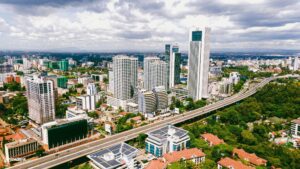
Buildings Along Woodvale Grove 1024x576

Westlands lies northwest of Nairobi CBD, about a 10-15 minute drive (3.2km) via Waiyaki Way under light traffic. On paper, that’s a short drive.

In reality, it’s a journey across economic worlds.

To the north and west, you’ll find Kitisuru and parts of Runda—quiet, leafy, guarded.

To the south, Kangemi and Githogoro—dense, energetic, and under pressure.

Five wards define this space:

  • Kitisuru
  • Parklands/Highridge
  • Karura
  • Kangemi
  • Mountain View

Each tells a different story.

Westlands Economy

Westlands is Nairobi’s second-largest commercial district after the CBD—and in some sectors, it has already overtaken it. The area runs on two engines.

The Global Economy

This is the Westlands you see online.

Corporate offices like Safaricom. Embassies. Tech firms. Hotels like Villa Rosa Kempinski and Sankara. Retail hubs like Sarit Centre and Westgate.

This makes Westlands a white-collar employment hub, attracting professionals such as:

  • Consultants
  • Developers
  • Executives
  • Remote workers earning in dollars

Salaries range from KSh 35K to over KSh 400k monthly.


The Survival Economy

Then there’s the other Westlands.

In Kangemi, Deep Sea, and Githogoro:

  • Small kiosks line the roads
  • Bodabodas wait for customers
  • Casual labourers hustle daily

This is where a large portion of the constituency survives.

Earnings? Often KSh 300–800 a day.


These two economies sit side by side—but rarely meet.

And that tension defines everything else.

Westlands Politics

Westlands is not a simple “ODM stronghold.” It’s a split-class voting constituency.

On paper, Westlands has 160,739 registered voters.

In reality, elections are decided by far fewer.

In 2022, turnout likely sat around 60–65%. That means over 50,000 people stayed home.

And here’s the twist:

The people who don’t vote are mostly:

  • Young professionals
  • Apartment renters
  • First-time voters 
  • Students

Meanwhile, turnout is strongest in:

  • Kangemi
  • Mountain View

That’s why Tim Wanyonyi (ODM) has held the seat since 2013—strong grassroots mobilisation beats passive urban voters every time.

His second term serving the constituency is coming to an end. This means people here will be voting in a new MP come 2027.

Who will that be? The answer lies within the people in this constituency. And it’s what will decide and shape the constituency for the next 5 years.

2027 Is Already Taking Shape

Westlands is quietly becoming one of Nairobi’s most interesting battlegrounds.

Why?

Because the math is simple.

If just 10–15% more middle-class voters show up, the seat could flip.

Watch for:

  • UDA making inroads in Parklands and Karura
  • Independent candidates targeting professionals
  • Youth-driven issue campaigns

Westlands is not locked. It’s just… under-participated.

What Residents Are Actually Dealing With

Forget the skyline for a second. Talk to people on the ground, and a different picture emerges.

1. Inequality Is Physically Visible

Drive from Kitisuru to Kangemi in under 10 minutes.

You’ll pass:

  • Gated mansions with high walls and electric fences
  • Then, informal settlements with shared toilets, open drainage

Same constituency. Different realities lived daily.

2. Infrastructure That Can’t Keep Up

Despite the wealth:

  • Roads like General Mathenge and parts of Westlands are deteriorating
  • Drainage systems are failing

Rapid construction is outpacing infrastructure upgrades.

One resident put it bluntly:

“A good portion of Westlands roads are very pathetic.”

3. Youth Locked Out

There are jobs in Westlands—but not for everyone.

Many young people are stuck in informal work even while opportunities exist just a few kilometers away. And corporate jobs are inaccessible without connections/networks.

4. Housing Pressure & Displacement

Westlands is becoming unaffordable.

  • Rent in Westlands for one-bedroom apartments: KSh 80K+ (mid-high end)
  • Family units: KSh 150K–250K

As prices rise, lower-income residents are pushed into already crowded areas like Kangemi.

5. Flooding in a “Modern” District

Even high-end areas flood.

Poor drainage and rapid development mean that when it rains, roads—and sometimes homes—go under. And vehicles get swept away.

What Can We Do?

Westlands is not broken—it’s misaligned.

The wealth exists.

The infrastructure exists.

The people exist.

What’s missing is coordination, accountability, and civic participation.

i. Local Efforts Already Exist

  • Friends of Karura Forest advocate for environmental conservation and public space protection
  • Kangemi Youth Groups (e.g., community CBOs) focus on skills training and sports programs
  • Shining Hope for Communities (SHOFCO) – Kibera origin, influences nearby

These groups are already doing the work:

  • Train youth
  • Improve sanitation
  • Provide education support

But they remain underfunded relative to the constituency’s wealth.

They’re also operating at a scale far below what the constituency actually needs.

ii. Get Out the Vote

Let’s be honest.

Westlands is full of people who:

  • Live here
  • Work here
  • Complain about governance

…but vote elsewhere—or not at all.

If even half of the ~50,000 non-voters show up in 2027, the entire political equation would change overnight.

And if you’re a first-timer, register as a voter today. Visit the nearest polling station with your original ID or passport. The process is simple and fast.

Already have a voter’s card? Verify voter details now and get ready for 2027.

iii. If You Live Here, Vote Here

This one matters.

Westlands has thousands of renters, professionals, and long-term residents.

But many still vote in rural home constituencies, weakening local accountability.

And if you’re one of them, you are not shaping the place you actually live.

Transfer your voter registration details. Then vote in Westlands because you live here full-time.

Representation should reflect reality.

iv. And Above All—Peace

Westlands has historically remained relatively stable during elections.

It must stay that way.

But economic frustration and youth unemployment can be easily exploited.

No politician is worth:

  • Your safety
  • Your future
  • Your community

Reject the manipulation. Protect the peace.

And security agencies must protect, not intimidate.

Now Is the Time

Westlands is Kenya in miniature.

It’s a place where:

  • Wealth is growing
  • Inequality is widening
  • Young people are watching

The next election will decide whether:

  • Inequality deepens
  • Infrastructure catches up
  • Citizens take ownership

This is not just about politics alone.

It’s about whether the people who live 3km from power finally choose to use it.

Scroll to Top