• Independent
  • Non-partisan
  • Evidence-led
Civic information for Kenya

Dagoretti North

Dagoretti North is a constituency of contrasts. In one direction are the apartments, offices, and busy streets of Kilimani and Kileleshwa.

In another are the tightly packed homes, markets, and small businesses of Kawangware, Gatina, and Kabiro.

Different neighbourhoods, different realities—but many of the same questions about how Nairobi grows and who benefits from that growth.

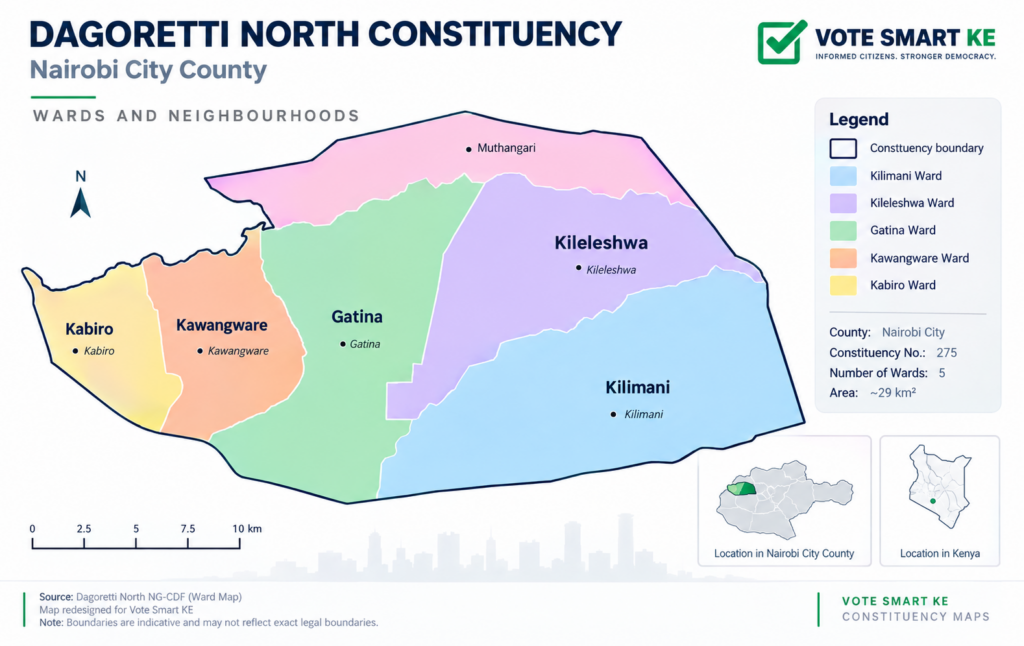
dagoretti north constituency map

Dagoretti North is in Nairobi County . It covers 29 km² . Its population is 238,015 . It has 157,656 registered voters. The constituency has 5 wards.

About Dagoretti North

Dagoretti North sits on the western side of Nairobi and packs very different neighbourhoods into just 29 km². It has five wards: Kilimani, Kawangware, Gatina, Kileleshwa and Kabiro.

Spend time across the constituency, and those differences are easy to see. Kilimani and Kileleshwa have seen apartments, offices and businesses reshape their streets. Kawangware, Gatina and Kabiro are much more densely settled, with homes, shops, markets and small businesses sharing limited urban space.

That contrast is part of what defines Dagoretti North. It is one constituency, but the everyday experience of living, working and getting around can look very different from one ward to the next.

The Story of Dagoretti North

Established 2013

Formation & Origin

Dagoretti North is one of Nairobi’s newer constituencies. It was created during the electoral boundary changes that took effect ahead of Kenya’s 2013 General Election.

Much of the area that became Dagoretti North had previously fallen within the former Westlands Constituency. The new seat brought Kilimani, Kawangware, Gatina, Kileleshwa and Kabiro together under one parliamentary constituency.

Dagoretti North went to the polls for the first time in March 2013, electing Paul Simba Arati of ODM as its first Member of Parliament.

Boundary History

Before Dagoretti North appeared on the electoral map, Nairobi’s constituency boundaries looked very different.

The former Westlands Constituency covered a much larger area, including neighbourhoods that today fall within Dagoretti North. The boundary review ahead of the 2013 election reorganised these areas as Nairobi gained additional constituencies.

The result was the present Dagoretti North electoral area, identified as Constituency No. 275. Its five wards have remained Kilimani, Kawangware, Gatina, Kileleshwa and Kabiro.

Name Origin

The name “Dagoretti” is much older than Dagoretti North Constituency, but exactly where it came from is uncertain.

One explanation links the name to entiakuletia, a Maasai word referring to vegetation found in the area. Another popular account traces it to the Kikuyu expression ndagurite.

The stories differ, and there is not enough authoritative evidence to treat either as the definitive origin. For now, the safest conclusion is simple: the exact origin of the name remains uncertain.

Historical Significance

Long before Dagoretti North became a constituency, the wider Dagoretti area was part of Nairobi’s outward expansion.

Research on Kawangware traces its growth to settlements that developed beyond the old colonial city boundary. People could live there while remaining close enough to Nairobi to find work. When the city’s boundary expanded in 1963, Dagoretti became more fully incorporated into Nairobi.

Decades later, that former urban edge is firmly inside the capital. Kawangware has grown into a dense residential and commercial centre, while Kilimani and Kileleshwa have undergone extensive redevelopment.

That journey—from Nairobi’s edge to part of its urban core—is an important part of Dagoretti North’s story today.

Politics in Dagoretti North

Political Profile

Dagoretti North has had just two MPs since the constituency was created in 2013.

Paul Simba Arati won the new seat in 2013 and successfully defended it in 2017, both times on an ODM ticket. In 2022, the constituency changed hands when Beatrice Elachi was elected MP, also on an ODM ticket.

Elachi was not new to Dagoretti North politics. She had challenged Arati for the seat in 2017 on a Jubilee Party ticket, receiving 34,686 votes against Arati’s 50,598. Five years later, she returned on an ODM ticket and won the seat.

Beatrice Kadeveresia Elachi is currently the elected MP for Dagoretti North and a member of ODM.

2027 Electoral Profile

The 2022 voter register provides the latest General Election baseline for Dagoretti North. IEBC recorded 157,659 registered voters across the constituency’s five wards.

Kilimani had the largest register, with 38,927 voters, followed by Gatina with 34,831. Kileleshwa had the smallest, with 26,343.

The figures below provide a 2022 baseline only. Vote Smart KE will add the corresponding 2027 figures when an applicable official IEBC register is published.

157,659
Registered voters

5
Electoral wards

2027
Next General Election

Ward 2022 Registered Voters 2027 Registered Voters
Kilimani 38,927 —
Kawangware 28,468 —
Gatina 34,831 —
Kileleshwa 26,343 —
Kabiro 29,090 —
Total 157,659 To be updated

Political Trends

Dagoretti North’s parliamentary history is relatively short because the constituency has existed only since 2013.

1. The Arati Years: 2013–2022

Paul Simba Arati was the first person elected to represent Dagoretti North in Parliament.

He won the newly created seat on an ODM ticket in 2013 and returned to voters four years later seeking a second term.

The 2017 race was more revealing. Arati received 50,598 votes, while Jubilee candidate Beatrice Elachi finished second with 34,686. Arati retained the seat and served until 2022.

His decision to leave constituency politics in 2022 opened the seat for a new representative.

2. Change in Representation: 2022–Present

Beatrice Elachi’s 2022 victory came five years after she had unsuccessfully challenged Arati for the same seat.

This time, however, she contested on an ODM ticket rather than Jubilee. She won and became Dagoretti North’s second MP.

Her election changed the individual representing the constituency but not the party holding the parliamentary seat: ODM had now won Dagoretti North in 2013, 2017 and 2022.

Elachi brought a different political résumé to the seat. Before becoming MP, she had served as Senate Majority Whip from 2013 to 2017, Speaker of the Nairobi City County Assembly from 2017 to 2021, and Chief Administrative Secretary in the Ministry of Public Service from 2021 to 2022.

What the Record Shows

One pattern is clear from Dagoretti North’s short parliamentary history: ODM has won the seat in every General Election since the constituency was created.

But the individual contest has changed. Arati represented the constituency for its first two terms. Elachi challenged him from another party in 2017, then returned five years later on an ODM ticket and won.

Three elections are still a relatively short history. Rather than treating that record as a prediction of how Dagoretti North will vote in 2027, it is better understood as the constituency’s electoral story so far.
Economy of Dagoretti North

Key economic activities, employment patterns, commercial assets and livelihood opportunities across the constituency.

Economic Profile

There is no single Dagoretti North economy.

Walk through Kawangware and much of the economy happens close to the street: shops, market stalls, food businesses, salons, workshops, transport services and other small enterprises support everyday livelihoods. Many residents also earn their living elsewhere in Nairobi and return home at the end of the day.

Kilimani and Kileleshwa tell another side of the story. Apartments, restaurants, hotels, offices, supermarkets and other service businesses have changed both neighbourhoods, creating work and investment while also increasing demand for land and commercial space.

Put together, Dagoretti North is an economy of small traders and professionals, landlords and tenants, casual workers and entrepreneurs. What happens to transport, housing, business space and the cost of operating in the city affects livelihoods here directly.

Key Economic Activities

Small Business & Informal Trade

For many households, the small business is the workplace. Shops, market stalls, food vending, salons, workshops and roadside enterprises form an important part of everyday commerce, particularly around Kawangware, Gatina and Kabiro.

These businesses depend heavily on affordable trading space, reliable services and the ability of customers and goods to move easily through the neighbourhoods.

Property & Construction

The changing skyline of Kilimani and Kileleshwa is also an economic story. Apartment construction and redevelopment support jobs in building, property management, maintenance and related services.

But growth comes with pressure. Residents of Kilimani and Kileleshwa have formally raised concerns with Nairobi City County over zoning, building approvals and whether infrastructure is keeping pace with development.

Retail, Food & Hospitality

Dagoretti North also serves customers well beyond its residential population. Kilimani and Kileleshwa have developed strong restaurant, retail, hospitality and service economies, while Kawangware supports a busy neighbourhood market and retail network.

Together, they create opportunities ranging from formal employment to supplying, delivery, food preparation and other supporting work.

Transport & Mobility Services

Movement is part of the local economy. Matatus, boda bodas, taxis, delivery riders and other transport services move residents between homes, markets, workplaces and the rest of Nairobi.

For traders and workers, the condition of roads, walkways and public transport connections is therefore more than a transport issue. It affects the time and cost of earning a living.

Professional & Service Economy

Not everyone who works in Dagoretti North works in the informal economy. Offices, schools, health facilities, hospitality businesses and professional services provide another layer of employment, especially around Kilimani and Kileleshwa.

This mix of formal and informal work is one reason the constituency can look economically different within just a few kilometres.

Employment & Livelihoods

For residents, the economic question is often less about what Dagoretti North produces and more about whether people can find dependable ways to earn.

Some run businesses from shops, markets or roadside spaces. Others work in construction, transport, hospitality and domestic or casual jobs. Professionals and salaried workers may commute to other parts of Nairobi, while businesses in Kilimani and Kileleshwa draw workers into the constituency.

Self-employment matters too. University of Nairobi research on women in Dagoretti North found business activity supported through savings, family networks, financial institutions, women’s groups and mobile-money credit—while also identifying financial skills and access to finance as areas where further support was needed.

Economic Opportunities

Dagoretti North already has the ingredients of a strong urban economy: customers, entrepreneurs, skilled workers, busy neighbourhood centres and proximity to Nairobi’s wider job market.

The opportunity is to make that economy work better at street level. Safer trading spaces can help small businesses. Better roads and walkways can make customers and workplaces easier to reach. Skills and access to finance can help enterprises grow. And well-managed development can create jobs without overwhelming the neighbourhoods that support them.

For Dagoretti North, economic growth is not only about attracting new investment. It is also about making it easier for the people already earning a living here to stay in business and move forward.

Projects & Public Investment in Dagoretti North

Documented public projects, investments and government programmes in Dagoretti North, with attention to both approved funding and reported implementation status.

Major Projects

Kawangware Road Improvements

Nairobi City County implementation records include road works affecting Elshadai Road and sections of Market Road in Kawangware, alongside works associated with the Kawangware Market area.

These projects are intended to improve local mobility and access within one of the constituency’s busiest residential and commercial neighbourhoods.

Implementing body: Nairobi City County Government
Reported status: Complete

Gatina Ward Improvements

County implementation records also identify the rehabilitation of Kibue Road and installation of public lighting within Gatina Ward.

Improved roads and street lighting can support movement, business activity, and access to services in densely populated neighbourhoods.

Implementing body: Nairobi City County Government
Reported status: Complete

Infrastructure Projects

Gatina Ward Improvements

County implementation records also identify the rehabilitation of Kibue Road and the installation of public lighting within Gatina Ward.

Improved roads and street lighting can support movement, business activity, and access to services in densely populated neighbourhoods.

Implementing body: Nairobi City County Government
Reported status: Complete

Education Investment

Dagoretti North NG-CDF supports education through bursaries and school infrastructure.

Published NG-CDF documentation has included allocations for secondary-school and tertiary education bursaries, while education infrastructure projects have targeted improvements to learning facilities.

A procurement process in 2025 also covered construction of a laboratory at Kawangware Primary School.

County & Constituency Projects

Public investment in Dagoretti North comes through different institutions.

Nairobi City County is responsible for devolved functions, including many local roads and county services, while NG-CDF supports eligible projects within its legally defined mandate, including areas such as education and security infrastructure.

Residents can therefore assess projects more accurately by identifying who funded them, who implemented them, their reported status, and whether they are delivering the intended results.

Priority Issues in Dagoretti North

Key local issues affecting residents, public services and the future development of the constituency.

Water & Sanitation

Strengthen access to reliable water, sanitation, and drainage systems, especially in high-density communities where infrastructure must serve large populations.

Infrastructure & Roads

Improve and maintain local roads, pedestrian routes, and supporting infrastructure to make movement safer and easier across densely populated, and rapidly developing neighbourhoods.

Housing & Urban Development

Manage continued residential and commercial development while ensuring roads, drainage, public spaces, and other services keep pace with increasing urban density.

Employment & Jobs

Expand opportunities for young people, traders, small businesses and entrepreneurs through skills development, enterprise support and improved access to economic opportunities.

Education

Improve learning environments, expand access to bursaries and skills development, and create stronger pathways between education and employment.

Security & Public Safety

Improve street lighting, community safety infrastructure, and coordination between residents and relevant security institutions.

Infrastructure & Roads

Getting Involved in Dagoretti North

Democratic participation in Dagoretti North extends beyond election day. Residents can take part in public participation forums, follow county and national budgets, engage elected representatives, monitor public projects, and participate peacefully in electoral processes.

01

Community Action

Many issues affecting daily life in Dagoretti North—including local roads, waste management, planning, and some public services—fall within county government responsibilities.

Residents can participate in Nairobi City County public consultations, budget processes, and ward-level forums to raise priorities and scrutinise proposed spending.

02

Register, Participate & Vote

Eligible residents should confirm that they are ready to participate in the 2027 General Election.

If you are not registered, follow IEBC’s voter-registration procedures when registration services are available. Already registered voters should verify their registration details and polling station through official IEBC channels.

Residents who have moved may also be eligible to apply to transfer their voter registration according to IEBC procedures and applicable deadlines.

Registration is only one part of participation. Learn about the candidates, compare their records and proposals, attend public forums, ask questions, and make your own informed choice.

03

Keeping Dagoretti North Peaceful

Dagoretti North brings together residents from different communities, backgrounds, and economic circumstances.

Political competition should not undermine these relationships. Residents, candidates, and supporters can contribute to peaceful elections by engaging respectfully, rejecting violence and intimidation, and respecting every citizen’s right to make independent political choices.

What Residents Can Watch

Public budgets, projects, and political promises should ultimately produce measurable improvements. These are practical questions residents can continue asking:

Are road, drainage, and pedestrian infrastructure projects keeping pace with population growth and increasing development?

Are water, sanitation, and waste-management services improving in densely populated neighbourhoods?

Are planning approvals and new developments being accompanied by adequate roads, drainage, public spaces, and other supporting infrastructure?

Are education bursaries and school investments reaching intended learners and producing measurable benefits?

Are public lighting and security investments improving safety and mobility across neighbourhoods?

Can residents clearly identify which projects are funded by Nairobi City County, NG-CDF, or other public institutions—and track how those funds are being used?

The Future of Dagoretti North

OUTLOOK

Dagoretti North’s future will be shaped by how effectively it manages continued urban growth while improving services across neighbourhoods with very different needs.

Kilimani and Kileleshwa continue to experience intensive residential and commercial development, while high-density areas such as Kawangware, Gatina and Kabiro require infrastructure capable of serving large populations.

Balancing these different pressures will require effective urban planning, reliable public services, economic opportunities, and transparent public investment.

Priorities for the Future

Manage Urban Growth

Ensure residential and commercial development is accompanied by adequate roads, drainage, water systems, public spaces, and other essential infrastructure.

Improve Mobility & Infrastructure

Strengthen local roads, pedestrian infrastructure, and transport connections to make movement safer and more efficient.

Strengthen Essential Services

Improve access to reliable water, sanitation, education, and other public services across densely populated neighbourhoods.

Expand Youth & Economic Opportunities

Support skills development, entrepreneurship, small businesses, and employment opportunities for the constituency’s growing urban population.

Strengthen Public Accountability

Make information about budgets, projects, implementing agencies, and results easier for residents to access and scrutinise.

Understanding Dagoretti North

Dagoretti North is a constituency shaped by density, diversity and rapid urban change.

Its neighbourhoods tell different stories. Kawangware, Gatina and Kabiro reflect the realities of high-density urban living and small-scale enterprise, while Kilimani and Kileleshwa illustrate Nairobi’s continuing apartment, commercial and service-sector expansion.

These differences create both opportunities and pressures. Development can bring investment, employment and new services, but population growth and construction also increase demand for roads, water, drainage, public spaces, schools and other infrastructure.

The broader development story of Dagoretti North therefore depends on whether urban growth translates into better living conditions and economic opportunities across all five wards.

Scroll to Top
Ask Vote Smart KEIndependent · Non-partisan · Evidence-led

Prefer a full page? Open the assistant in a new tab.