• Independent
  • Non-partisan
  • Evidence-led
Civic information for Kenya

Embakasi Central

Embakasi Central moves to the rhythm of everyday city life. Across Kayole, Komarock, and Matopeni/Spring Valley, busy streets connect homes, shops, schools, and thousands of people moving through the constituency each day.

Different neighbourhoods, different pressures—but many of the same questions about roads, public services, economic opportunity, and whether development is keeping pace.

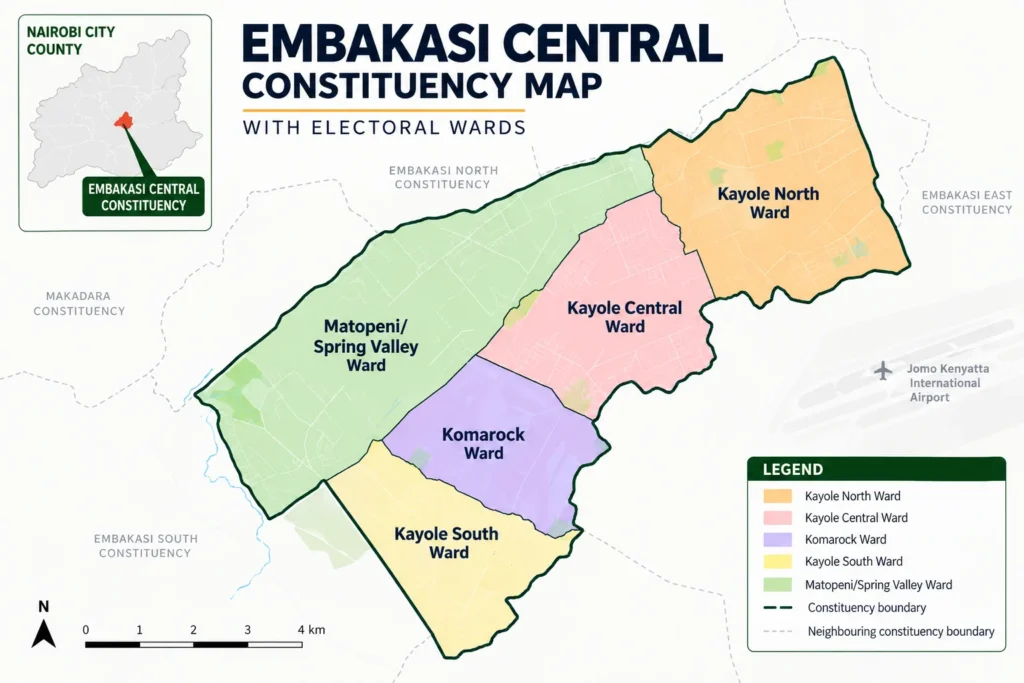
Map of Embakasi Central Constituency showing Kayole North, Kayole Central, Kayole South, Komarock and Matopeni/Spring Valley wards.

Embakasi Central is in Nairobi County . It covers 14.3 km² . Its population is 257,730 . It has 145,892 registered voters. The constituency has 5 wards.

About Embakasi Central

Embakasi Central is one of Nairobi City County’s 17 constituencies, located in the eastern part of the city. Covering approximately 14.3 square kilometres, it is divided into five electoral wards: Kayole North, Kayole Central, Kayole South, Komarock and Matopeni/Spring Valley.

Much of the constituency is closely built and highly urban, with residential neighbourhoods sitting alongside busy shopping streets, schools, markets and transport routes. Kayole accounts for three of the five wards, while Komarock and Matopeni/Spring Valley add their own residential and commercial character.

This compact urban setting shapes many of Embakasi Central’s everyday challenges. Roads, drainage, water, schools, public spaces and other services must serve communities concentrated within a relatively small area.

Understanding Embakasi Central therefore means looking beyond the constituency as a single place. Each ward has its own neighbourhoods and local pressures, even as residents share many of the same concerns about infrastructure, services and the quality of urban life.

The Story of Embakasi Central

Established 2012

Formation & Origin

Embakasi Central took shape during Kenya’s major electoral boundary review ahead of the 2013 General Election.

Before then, much of eastern Nairobi was represented through the much larger Embakasi Constituency. The 2012 boundary review reorganised this area into smaller parliamentary units, creating Embakasi Central alongside Embakasi North, Embakasi South, Embakasi East and Embakasi West.

The new Embakasi Central Constituency was assigned electoral code 284 and brought together five wards: Kayole North, Kayole Central, Kayole South, Komarock and Matopeni/Spring Valley.

It elected its first Member of Parliament in March 2013.

Boundary History

Today’s Embakasi Central is part of a much longer electoral story in eastern Nairobi.

Before the 2013 elections, the old Embakasi Constituency covered a far larger part of the city’s Eastlands area. As Nairobi grew, the 2012 delimitation exercise redrew the electoral map and replaced that larger constituency with several smaller seats.

Embakasi Central emerged from that reorganisation with boundaries centred on the three Kayole wards, Komarock and Matopeni/Spring Valley.

Those five wards remain the clearest way to distinguish Embakasi Central from the neighbouring constituencies that still carry the Embakasi name.

Name Origin

The name Embakasi Central reflects the constituency’s place within the group of Embakasi constituencies created through the 2012 electoral boundary reorganisation.

“Central” distinguishes it from Embakasi North, South, East and West.

The name Embakasi itself is much older than the present constituency. However, Vote Smart KE has not found a sufficiently authoritative historical source establishing its exact linguistic or cultural origin. Rather than repeat an unverified explanation, the origin of the older name remains open until reliable historical evidence is available.

Historical Significance

The creation of Embakasi Central gave Kayole, Komarock and Matopeni/Spring Valley a more distinct voice in Nairobi’s parliamentary map.

Instead of forming part of the much larger former Embakasi Constituency, these communities began electing their own Member of Parliament from 2013.

John Ndirangu Kariuki of The National Alliance (TNA) became Embakasi Central’s first MP after the March 2013 General Election. His election marked the beginning of the constituency’s independent parliamentary history.

More than a decade later, the constituency has developed its own political and development record. That history can now be traced through elections, public investment, and shifting priorities across its five wards.

Politics in Embakasi Central

Political Profile

Embakasi Central has had two Members of Parliament since its first election in 2013.

John Ndirangu Kariuki became the constituency’s first MP in 2013. The seat changed hands in 2017 when Benjamin Gathiru Mwangi, commonly known as Mejjadonk, was elected to the National Assembly.

Mejjadonk retained the seat in the 2022 General Election and is the current Member of Parliament for Embakasi Central. Parliament lists him as a member of the United Democratic Alliance (UDA).

His parliamentary record extends beyond constituency representation. During the 12th Parliament, he served on the National Government Constituencies Development Committee and the National Cohesion and Equal Opportunity Committee. In the current Parliament, he has also sponsored the Public Service Commission (Amendment) Bill, 2023, which proposed changes to mandatory retirement in the public service.

2027 Electoral Profile

Embakasi Central had 145,892 registered voters in the 2022 General Election.

But that electorate was not evenly distributed across its five wards.

Ward Registered voters — 2022 2027 register
Kayole North 25,563 To be updated
Kayole Central 26,855 To be updated
Kayole South 41,154 To be updated
Komarock 33,127 To be updated
Matopeni/Spring Valley 19,193 To be updated
Total 145,892 To be updated

Kayole South had the constituency’s largest registered electorate in 2022, with 41,154 voters. Matopeni/Spring Valley had the smallest, at 19,193.

These figures provide a useful baseline for understanding Embakasi Central’s electoral geography, but they should not be confused with population or voter turnout.

Vote Smart KE will update the figures when IEBC publishes the applicable voter register for the 2027 General Election.

Political Trends

Embakasi Central’s parliamentary history is relatively short. Since the constituency first went to the polls in 2013, it has had two MPs and has moved through three different governing-party labels at the constituency level: TNA, Jubilee and UDA.

1. The Kariuki First Term: 2013–2017

Embakasi Central’s first parliamentary election in 2013 was won by John Ndirangu Kariuki of The National Alliance (TNA).

His victory established the constituency’s first representation in the National Assembly following the creation of Embakasi Central ahead of the 2013 election.

Kariuki served one term before losing the seat in 2017.

2. The 2017 Changeover

The 2017 General Election brought Embakasi Central its first change of MP.

Benjamin Gathiru Mwangi (Mejjadonk) won the parliamentary seat on a Jubilee Party ticket, replacing Kariuki after one term.

The election marked a change in individual representation while keeping the constituency within a party associated with the broader Jubilee political coalition of that period.

3. The Mejjadonk Era: 2017–Present

Mejjadonk retained the Embakasi Central seat in the 2022 General Election, giving him a second consecutive term in Parliament.

His second term also came under a different party banner. While he entered Parliament through Jubilee in 2017, Parliament currently lists him as a member of the United Democratic Alliance (UDA).

That means Embakasi Central has had the same MP since 2017, even as the party label attached to its parliamentary representation changed.

What the Trend Shows

Embakasi Central’s first three elections show more continuity in individual representation than the changing party labels might initially suggest.

The constituency changed MPs once—from John Ndirangu Kariuki to Benjamin Gathiru Mwangi in 2017. Mejjadonk then retained the seat in 2022 and is serving his second consecutive term.

At the same time, the parliamentary seat has been associated with TNA in 2013, Jubilee in 2017, and UDA in the current Parliament. That reflects changes in Kenya’s wider party landscape as well as the constituency’s own electoral history.

With only three parliamentary elections completed since Embakasi Central was created, there is still a limited record from which to identify longer-term voting patterns. The 2027 General Election will provide another point of comparison for whether the constituency continues with its current representation or undergoes another change.
Economy of Embakasi Central

Key economic activities, employment patterns, commercial assets and livelihood opportunities across the constituency.

Economic Profile

Embakasi Central’s economy is rooted in the everyday life of its neighbourhoods.

Across Kayole, Komarock and Matopeni/Spring Valley, shops, markets, workshops and service businesses operate close to where people live. Many residents also commute to jobs and businesses elsewhere in Nairobi, making transport links an important part of the local economy.

Small-scale trade is especially visible. From food vendors and neighbourhood shops to salons, repair businesses and transport services, much of the constituency’s commercial activity happens at street and estate level.

This means the local economy depends heavily on the environment around it. Passable roads, reliable water, drainage, electricity, security and organised trading spaces can directly affect how easily residents work and businesses operate.

Key Economic Activities

Retail & Small-Scale Trade

Shops, kiosks, food businesses, and informal traders serve the daily needs of Embakasi Central’s large residential communities. Kayole’s busy commercial streets are particularly important to this neighbourhood economy.

Markets

Markets provide trading space and support livelihoods for traders, suppliers and other small businesses. Kayole 1 Market in Kayole North is one of the constituency’s notable public trading spaces. Nairobi City County’s project implementation report lists its rehabilitation at approximately KSh 19.5 million and records the project as ongoing. Nairobi City County

Transport & Delivery Services

Matatus, boda bodas and delivery services connect residents to workplaces, markets and businesses both within the constituency and across Nairobi. Their activity also supports businesses that depend on the movement of customers and goods.

Services & Skilled Trades

Salons, barbershops, repair shops, workshops and other neighbourhood services provide income while meeting everyday needs close to home.

Construction & Property Services

A densely built urban environment also creates work in construction, repairs, maintenance and other property-related services.

Economic Opportunities

Embakasi Central’s dense population creates a ready market for goods and services. That gives neighbourhood businesses opportunities in retail, food, transport, repairs, personal services, and other forms of local enterprise.

Improving trading infrastructure could strengthen that existing economy. The ongoing rehabilitation of Kayole 1 Market is one example of public investment intended to improve formal trading space within the constituency.

Better roads and drainage can also make it easier for customers and deliveries to reach businesses, while reliable water, lighting and waste collection improve the environment in which traders operate.

For young people, skills development and access to enterprise opportunities are another part of the picture. But programmes should be judged by what they actually provide: who qualifies, what skills or financing are offered, how beneficiaries are selected, and whether the support leads to usable economic opportunities.

Embakasi Central does not need to invent an economy from scratch. Much of the opportunity lies in making its existing neighbourhood economy work better for the people already earning a living within it.

Projects & Public Investment in Embakasi Central

Documented public projects, investments and government programmes in Embakasi Central, with attention to both approved funding and reported implementation status.

Major Projects

Kayole Police Station

Embakasi Central NG-CDF funded the construction of a perimeter wall at Kayole Police Station during the 2020/21 financial year.

The project cost KSh 10.45 million and is listed by the fund as complete.

Security Lighting

NG-CDF implementation records also document investment in high-mast security lighting.

The 2021/22 programme allocated KSh 5 million each for 30-metre security masts at the Komarock Chief’s Office, Kayole Police Station and the Embakasi Sub-County Assistant County Commissioner’s Office.

In the implementation report dated 30 June 2022, the three projects were recorded as ongoing and 50% complete. Their current status requires a newer implementation record before they can be described as completed.

Education Investment

Education is one of the clearest areas of documented NG-CDF investment in Embakasi Central.

The approved 2022/23 programme allocated KSh 18.25 million to Thawabu Primary School for an eight-classroom, one-storey building. Another KSh 18.25 million was allocated for a similar eight-classroom project at Kayole North Primary School.

Both projects were listed as new in the approved proposal. That confirms the allocations, but not their eventual completion.

Government Programmes

Public investment in Embakasi Central is not limited to buildings.

NG-CDF records include secondary and tertiary bursaries, sports programmes, emergency funding, and other constituency programmes alongside physical projects.

For example, the 2021/22 implementation report records approximately KSh 2.74 million for constituency sports activities involving football and volleyball teams. The same report documents emergency funding that was used to rehabilitate the field at Komarock South Primary School.

These programmes show another side of constituency development: public funds can support education access, youth activities and community needs as well as construction.

County & Constituency Projects

Not every project in Embakasi Central is an NG-CDF project.

Nairobi City County’s current implementation records list the rehabilitation of Kayole 1 Market in Kayole North, valued at approximately KSh 19.50 million, as ongoing.

That distinction matters for accountability. School projects and bursaries funded through NG-CDF should be traced to the constituency fund, while county-funded markets, roads and other devolved services should be followed through Nairobi City County.

For residents, the useful question is therefore not simply “What projects have been announced?” It is who funded them, who is responsible for implementation, what was allocated, and what stage has actually been reached.

Priority Issues in Embakasi Central

Key local issues affecting residents, public services and the future development of the constituency.

Infrastructure & Roads

Complete the stalled Kayole One and Cheers roads and improve local access, drainage, and pedestrian movement in Kayole North. Nairobi County’s current project register still lists their construction as ongoing.

Drainage & Flooding

Keep drains and streets clear along Kayole, Mugendi and Diwopa/Bondeni roads, where county teams carried out drainage unclogging, garbage removal and cleaning during the 2026 rains.

Waste Management

Repair the broken sewer affecting the D5/Kioi area of Kayole, where untreated sewage has flowed past homes and businesses, and residents have raised concerns about health and lost trade.

Water & Sanitation

Expand sewer coverage in Matopeni and Kayole, where sanitation infrastructure remains a documented concern. Nairobi Water tendered the Matopeni–Kayole Sewer Works in 2026, making implementation an important project to track.

Markets & Trade

Complete the rehabilitation of Kayole 1 Market and ensure traders have clean, safe, and functional spaces to work. Nairobi County’s implementation records list the project as ongoing.

Education

Follow through on planned classroom expansion at Kayole North Primary School and Thawabu Primary School, where NG-CDF records allocated KSh18.25 million each for eight-classroom blocks.

Getting Involved in Embakasi Central

Residents do not have to wait for an election to influence what happens in Embakasi Central.

County budgets, NG-CDF priorities, and local development projects all provide opportunities for public participation. The important part is turning everyday concerns into specific proposals that can be followed through in budgets and implementation.

01

Community Action

Public participation works best when residents bring specific neighbourhood priorities rather than broad complaints.

Embakasi Central residents have already used county forums to raise issues such as Bidii access roads in Kayole North, sewer expansion in Matopeni, Kayole South–Ndege Road, public toilets, street lighting and improvements at Kayole II Level IV Hospital.

Residents can continue tracking whether priorities submitted at forums appear in county budgets, procurement records, and completed projects. NG-CDF also provides for residents to participate in open meetings where constituency development priorities are identified.

02

Register, Participate & Vote

Know your ward before you vote: Kayole North, Kayole Central, Kayole South, Komarock, or Matopeni/Spring Valley. Each ward elects an MCA, while voters across all five wards elect the Embakasi Central MP.

Check your registration details through IEBC, follow candidate records and proposals, and understand which office is responsible for the issue you care about.

A local road or market may fall under Nairobi City County, while an NG-CDF-funded school project follows a different accountability route. Knowing the difference makes it easier to ask the right leader the right question.

03

Keeping Embakasi Central Peaceful

Kayole, Komarock and Matopeni/Spring Valley bring together residents from different backgrounds and political views.

Campaign periods should not change people’s right to live, work, trade and move safely through their neighbourhoods.

Challenge candidates on roads, sewers, schools, markets and public spending. Debate political choices strongly where necessary—but reject intimidation, threats and violence, and respect every resident’s right to make their own political choice.

What Residents Can Watch

Public records show projects and priorities across Embakasi Central at different stages—from proposals and tenders to ongoing and completed works. The next step is to check whether those commitments translate into services residents can actually use.

Are the Kayole One, Cheers, and Horizon/Stanjo road projects moving from procurement and stalled works to completed, usable roads?

Are flooding, blocked drainage, and sewer problems in Kayole, Komarock, and Matopeni being addressed with lasting solutions rather than temporary clean-ups?

Were the planned classroom blocks at Thawabu and Kayole North Primary Schools completed, equipped, and opened to learners?

Is the Kayole 1 Market rehabilitation being completed as planned, and are traders getting clean, safe, and functional spaces to work?

Are NG-CDF bursaries reaching eligible secondary and tertiary students through a clear, transparent, and accountable process?

Are priorities raised by Embakasi Central residents—such as sewers, roads, lighting, markets, and Kayole II Level IV Hospital—making it from public participation forums into funded and completed projects?

The Future of Embakasi Central

Embakasi Central is still growing and changing. Across Kayole, Komarock and Matopeni/Spring Valley, the question for the years ahead is whether roads, drainage, sanitation, schools, markets and other public services can keep pace with everyday urban life.

OUTLOOK

The constituency does not lack projects or development plans. The bigger challenge is turning them into finished, reliable infrastructure that residents can actually use.

Road works in Kayole, sewer expansion around Matopeni, drainage improvements, new classrooms and the rehabilitation of Kayole 1 Market all point to where investment is already being directed.

The future therefore depends as much on completion and maintenance as new investment. Roads need working drainage. Sewer projects need to reach affected neighbourhoods. New classrooms need to open to learners. Markets need to work for the traders they were built to serve.

For Embakasi Central, progress will increasingly be measured not by how much is announced, but by what changes on the ground.

Priorities for the Future

Complete Ongoing Projects
Finish stalled and ongoing roads, classrooms, market, and sewer works before unfinished projects accumulate.

Fix Drainage for the Long Term
Prioritise flood-prone parts of Kayole and Komarock and integrate proper drainage into road upgrades.

Expand Sewers in Kayole & Matopeni
Extend sewer infrastructure to underserved neighbourhoods and resolve recurring broken sewer problems.

Keep Schools Ahead of Demand
Complete planned classrooms, maintain learning facilities, and keep bursary support accessible and transparent.

Strengthen Local Trading Spaces
Complete Kayole 1 Market and improve sanitation, access, and basic infrastructure around neighbourhood trading areas.

Understanding Embakasi Central

Embakasi Central is easy to associate with the busy streets of Kayole. But the constituency’s story is bigger than any one neighbourhood.

It is found in the traders opening their businesses each morning, the matatus and boda bodas moving people across the city, the schools serving growing communities, and the families who call Kayole, Komarock and Matopeni/Spring Valley home.

It is also found in the roads, drains, sewer lines, markets and public facilities that shape everyday life. When these systems work, neighbourhoods move more easily. When they fail, the effects are felt quickly by residents and businesses.

Embakasi Central’s challenge is therefore not simply to attract more development. It is to ensure that existing and future investment produces better services, stronger neighbourhoods and more opportunity for the people who live and work here.

Understanding Embakasi Central means looking beyond project announcements to ask what was delivered, who benefited, and whether everyday life is actually improving.

Stay informed. Ask questions. Participate. And vote.

Sources & Methodology

Vote Smart KE compiles constituency information from official electoral records, parliamentary records, government documents, constituency development records, historical research, and other credible public sources.

Electoral figures are based on official IEBC records where available. Political and development information is presented for civic information and does not mean an endorsement of any candidate, political party, or political position.

Where a project is documented as proposed, allocated, tendered, ongoing, or planned, Vote Smart KE does not present it as completed unless an appropriate source confirms completion.

Key Sources

Information last reviewed:
Scroll to Top
Ask Vote Smart KEIndependent · Non-partisan · Evidence-led

Prefer a full page? Open the assistant in a new tab.